RETURN_TO_REGISTRY
Designing and integrating a heavy plastics wash line — from bale to clean flake
#IndustrialAutomation#ControlSystems#ControlsEngineering#SystemIntegration#PLC#PROFINET#IIoT#FunctionalSafety#Industry40#ProcessAutomation#ModbusTCP#Siemens#PlasticsRecycling#SystemsArchitecture#Manufacturing
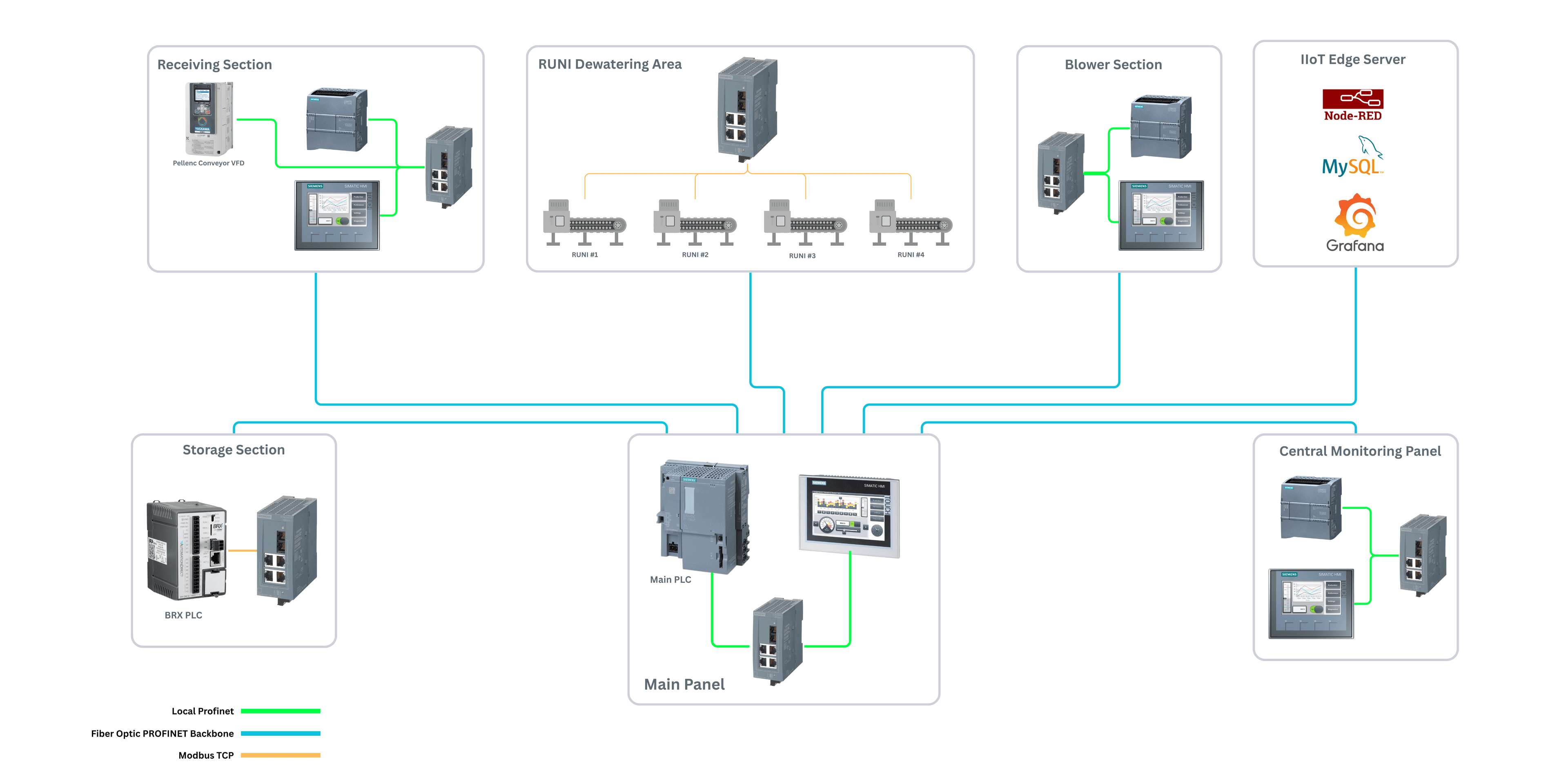
I led the control architecture, industrial networking, and project management for a multi-stage plastic washing and sorting line. It was one of those projects where the interesting part wasn't any single machine — it was making a dozen of them, from different vendors speaking different protocols, behave as one coordinated, safe system.
A retrofit, not a clean slate.
This wasn't a greenfield build — it was modernizing a live wash line. We stripped out an obsolete legacy PLC platform, built new control panels from the ground up, and re-engineered the plant's power capacity, which was running near its ceiling with no headroom. The upgrade added the margin to bring extra motors online and run the full process reliably.
One network, many dialects.
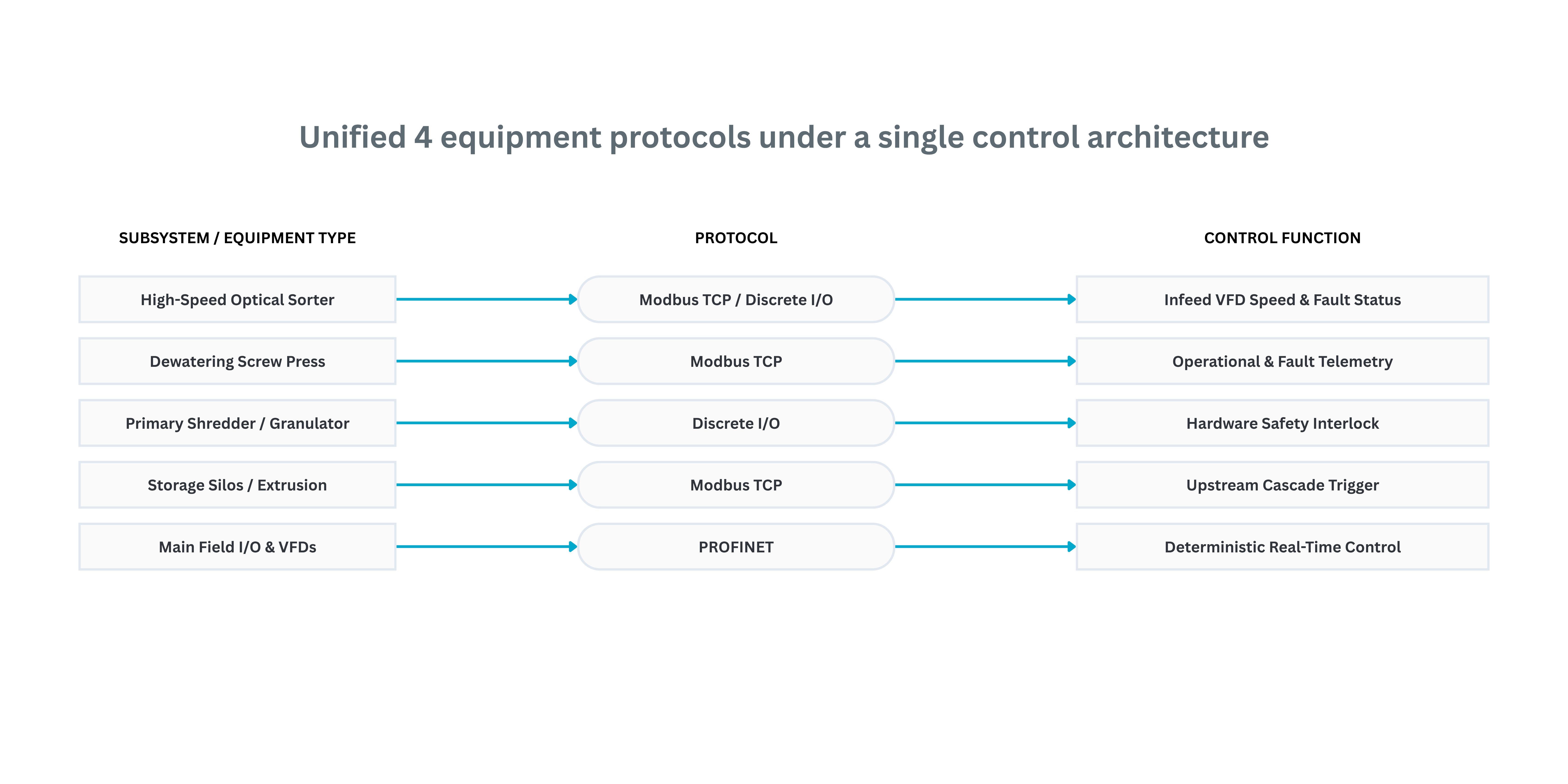
The plant runs on a fiber-optic PROFINET backbone (Siemens Scalance) linking distributed PLCs across the receiving, wash, dewatering, and blower sections. Fiber gave us total noise immunity next to a lot of high-power VFDs. Onto that backbone I integrated specialized European OEM machinery — a Pellenc optical sorter and RUNI dewatering presses — alongside legacy controllers, bridging Modbus TCP, discrete I/O, and hardwired interlocks without touching OEM code or voiding warranties. The optical sorter's feed conveyor speed is modulated live over Modbus TCP to keep detection density in the sweet spot; the dewatering presses are polled non-invasively for operational and fault states.
 Knowing where your scope ends.
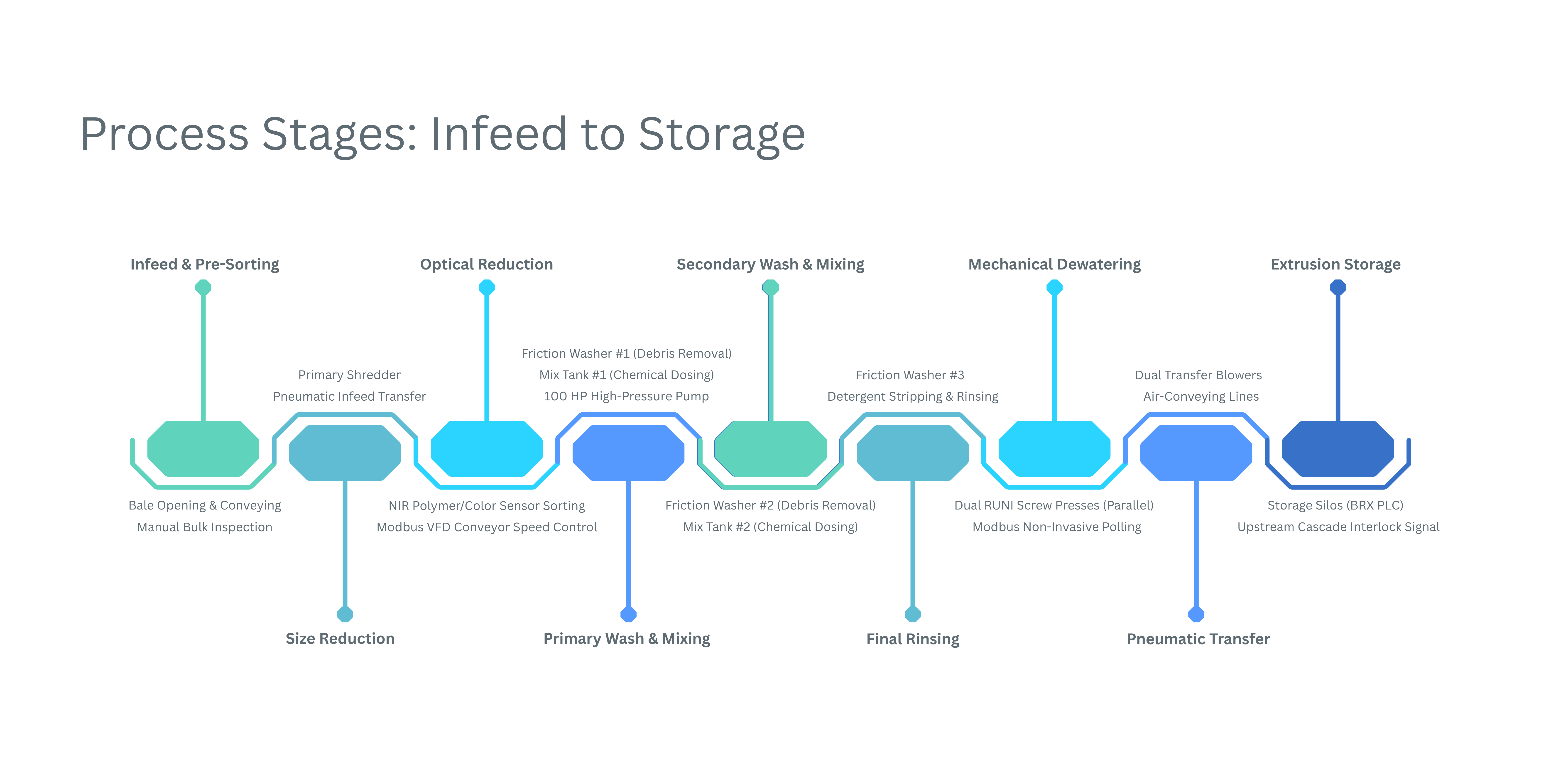
The line delivers clean flake to storage silos, which feed a downstream EREMA extrusion system. We don't control the extruder — but the silos' high-level signals trigger an upstream cascade shutdown on our side: silo full or downstream fault → open the shredder interlock → halt the infeed, while the wet stages run a timed purge sequence to clear in-flight material for a clean cold restart. Protecting expensive mechanical equipment from a jam is worth more than a few seconds of uptime.
 Safety in layers.
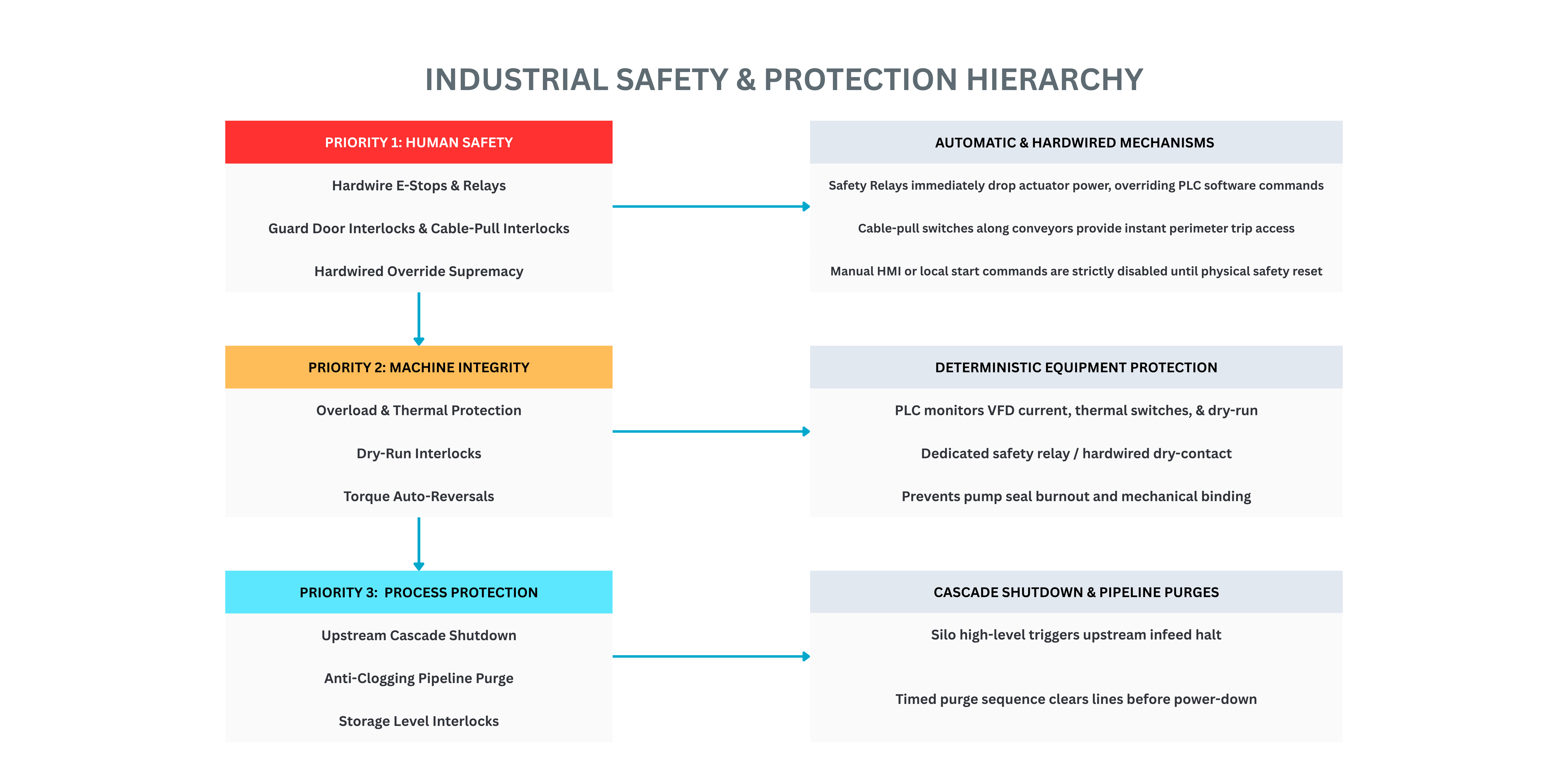
The design enforces a strict three-tier hierarchy: human safety first (hardwired E-stops, guard interlocks, and cable-pull switches on dedicated safety relays that override any PLC or HMI command), then machine integrity (overload/thermal protection, dry-run interlocks, torque auto-reversals), then process protection (cascade shutdowns and anti-clogging purges). Software never gets a vote over a hardwired safety circuit.
 Visibility without compromising determinism.
A dedicated IIoT edge server (Node-RED → MySQL → Grafana) polls process variables, faults, and throughput over the backbone, giving operators real-time dashboards and historical trends — without adding cycle-time overhead to the PLCs doing the real-time work.
Delivered lean.
Budgeted at roughly $2M, we came in around 60% of that by keeping the control-system integration in-house — protocol bridging, PLC programming, safety logic, and the IIoT layer — and contracting out only the heavy power infrastructure. Doing the integration ourselves is what made the number work.
The through-line of the whole project: heterogeneous equipment, unified control, safety that can't be overridden by software, and data that stays out of the critical path.
Happy to talk shop on any of it — protocol bridging, cascade interlocking, or industrial IIoT.

Oscar Calix
Sr, Control System Engineer
Cloud computing for OT, industrial data pipelines, SCADA supervision, full-stack tools for automation workflows..